
;%20stroke-width:%200px;%20}%20%3c/style%3e%3clinearGradient%20id='linear-gradient'%20x1='114.67'%20y1='158.28'%20x2='39.29'%20y2='21.4'%20gradientUnits='userSpaceOnUse'%3e%3cstop%20offset='0'%20stop-color='%230578a0'/%3e%3cstop%20offset='1'%20stop-color='%2305a0a0'/%3e%3c/linearGradient%3e%3c/defs%3e%3cg%20id='Layer_1-2'%20data-name='Layer%201'%3e%3cpath%20class='cls-1'%20d='m104.99,99.56c12.83-6,29.05-20.09,29.05-46.66C134.04,24.03,113.7,0,75.95,0H0v105.03l31.49-39.84-.55-5.04,2.3-3.9.45-.22s-1.8-11.45,5.36-18.88c.13.02,30.4,10.1,45.68,42.53,0,0-6.64,6.73-16.97,6.58l-.12.41s-2.25,1.93-3.52,2.31c-.75-.17-6.28-.1-6.28-.1l-8.96,6.95,29.71,58.24h55.67l-29.29-54.52Zm-8.39-41.88s0,9.73-8.29,18.43c0,0-10.56-30.32-47.39-42.36,0,0,15.1-17.26,38.89-6.38.92.63,18.2,7.41,16.79,30.31Z'/%3e%3c/g%3e%3c/svg%3e)
How The Winter Ramble runs a county-wide Appalachian music festival from one place
Four days of mountain music in rooms across Henderson County, North Carolina, planned by one producer. We built the festival's screening, committee, venue and budget tools with him, one working session at a time.
The short version
The Winter Ramble is a celebration of traditional mountain music that takes over Henderson County, North Carolina, for four days every February. There is no main stage: the festival happens in the county's breweries, vineyards, listening rooms and theaters, each one hosting its own part of the weekend. Producer Ryan Price plans all of it, and for its second year he set out to turn a loose network of venues into one festival with one plan and one budget. Since March we have met with Ryan more than ten times and built the tools he runs it on: screening for more than 150 acts, a committee that scores them, a planning board for every room, and a budget that keeps itself up to date. The festival is February 25 - 28, 2027. We will update this story with what he learns.
About the festival
A celebration of Appalachian music, in rooms across a county
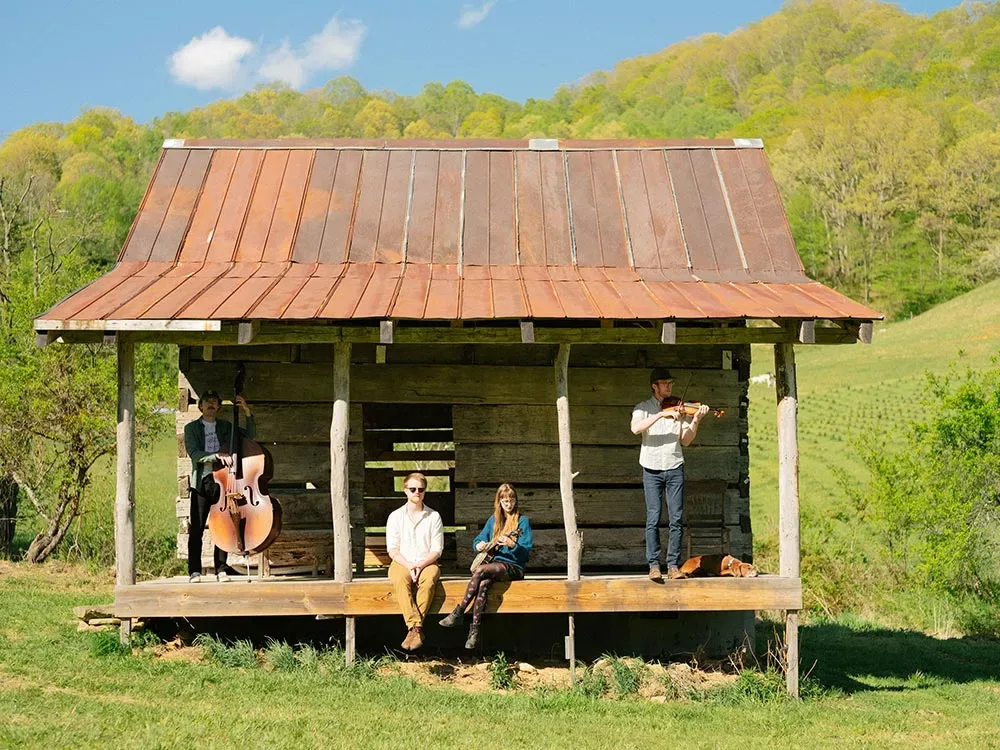
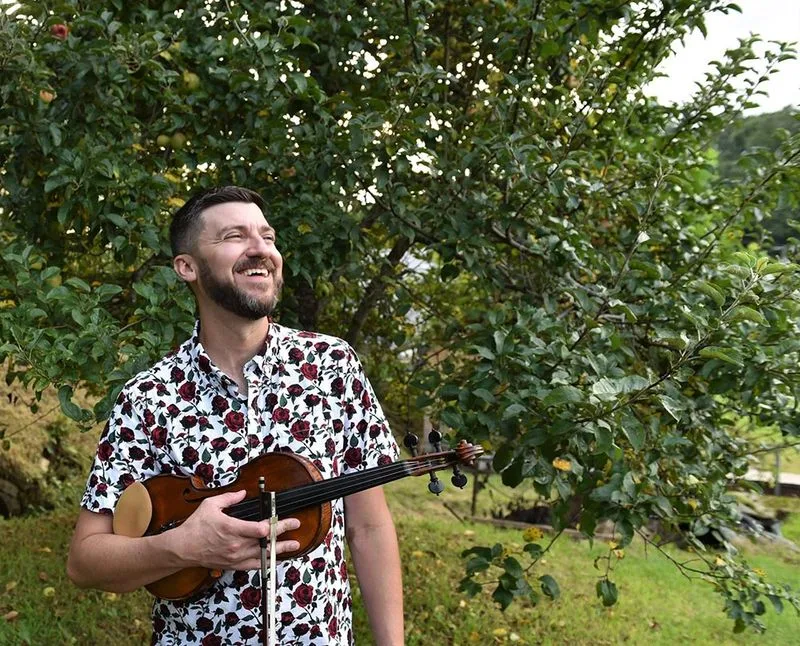
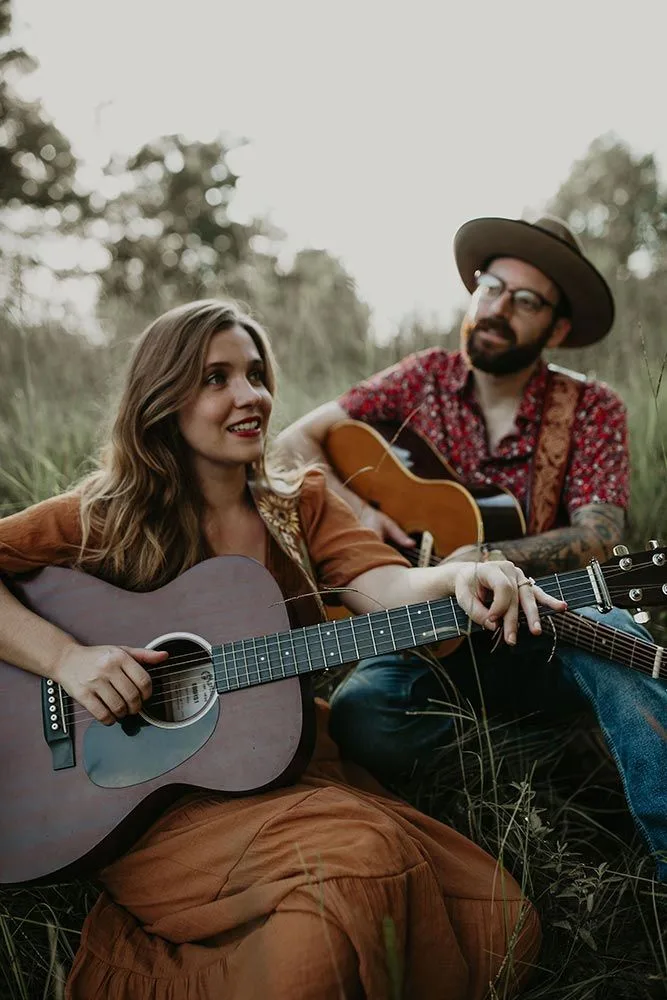
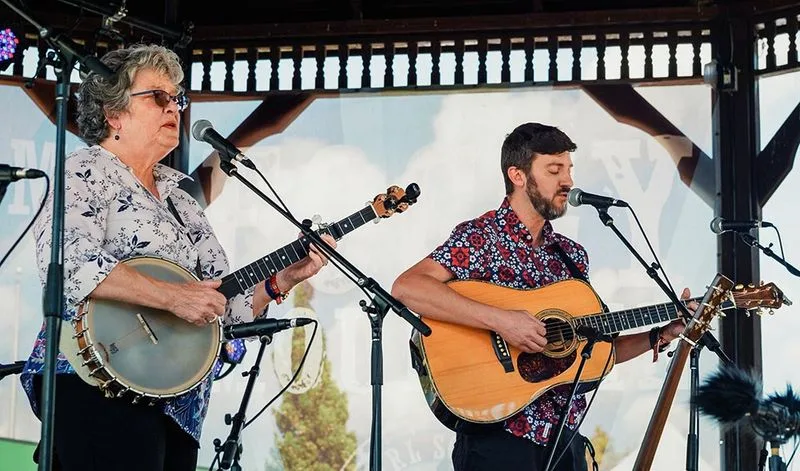
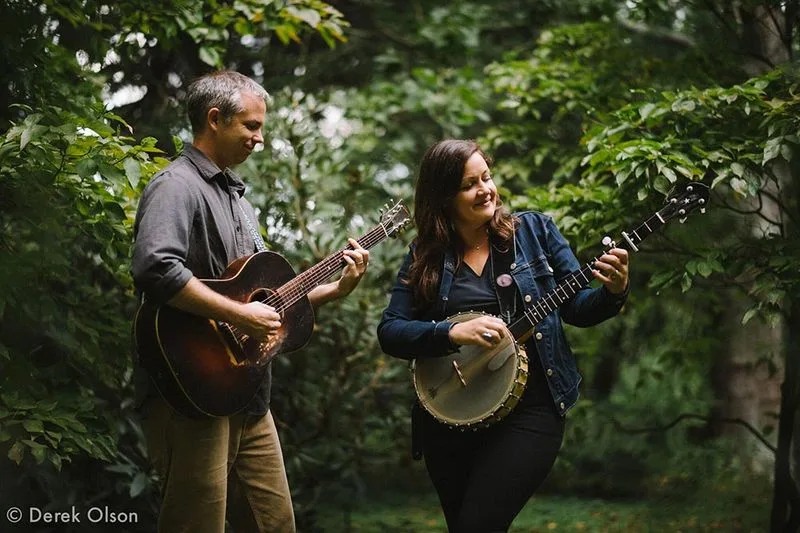
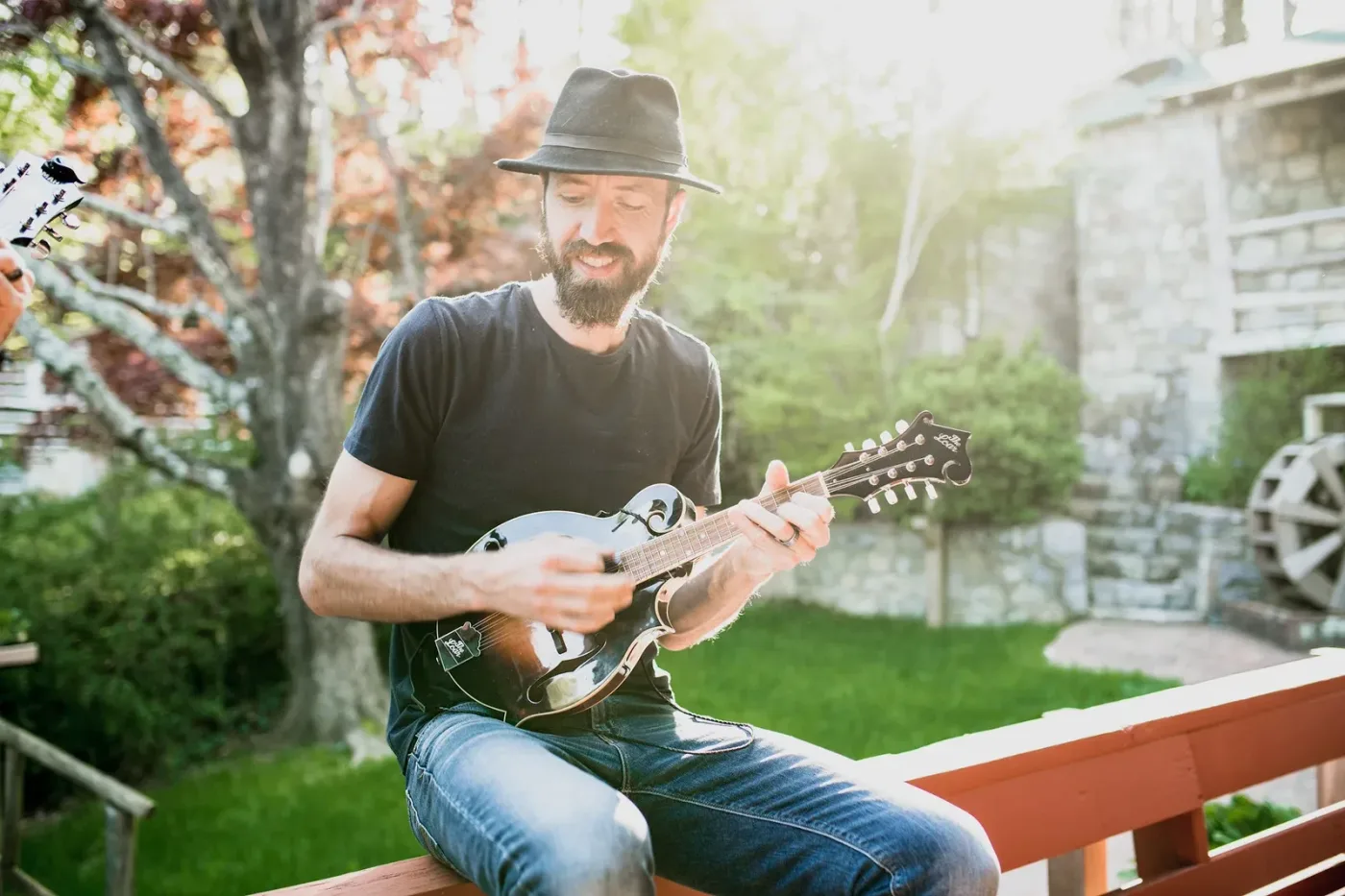
The Winter Ramble celebrates the music of the mountains and the people carrying it forward: old-time string bands, ballad singers, bluegrass and gospel, and the songwriters shaped by them. Alongside ticketed concerts it programs workshops, jam sessions, dance, storytelling and shape-note singing, and its home is Henderson County, with support from the county's Tourism Development Authority.
The festival does not build a stage. It works with the places already there: breweries and taprooms, vineyards, barns, churches, listening rooms and theaters. Each venue partner hosts its share of the weekend, and the festival handles booking, promotion and ticketing for all of them.
The challenge
One producer, a county full of venues, and nothing tying them together
Every venue ran on its own. In its first year, the Winter Ramble worked more like a coordinator than a festival. Each venue booked and paid its own acts, and each sold tickets on its own system. Even at rooms Ryan knew well, he could not see sales at a glance.
The festival was growing fast. The second year brings more venues, more than three times as many ticketed shows, and a screening list of more than 150 acts. Spreadsheets could hold the list. They could not move an act from first contact to a confirmed slot in the right room.
Programming is a committee decision. Acts are chosen with a curation committee of volunteers, each with their own view of what belongs at the Ramble. Gathering their opinions across shared sheets and side conversations made it hard to see where the group actually stood.
The money had to add up, room by room. The festival's goal is to become financially stable over its first few years. That means knowing what each venue's talent costs, what each free show needs, and what sponsors have actually committed, all while the deals are still moving.
Roadi is the keeper, the source of truth.
The partnership
Built with a producer, in the middle of producing
Ryan is a design partner. He shaped the festival account while he was using it to plan a real festival, which meant every feature was tested against a real decision the week it shipped.
More than ten working sessions ran between March and October 2026, with Ryan and Roadi.
It was built on his real festival. Last year's schedule, artists, venues and sponsors went in early, so the tools were judged against data Ryan already knew.
Work shipped between sessions. An ask from one call was usually on screen by the next, and Ryan's feedback set what came after.
That's why I'm excited about being part of this at this early stage. What you've built here is really powerful. Now I just gotta get in and populate it. This is gonna be my system for this year.
He asked, we built
A real festival budget, not a spreadsheet
A budget with planned and actual for every category, and a talent budget for every venue that fills in as acts are booked
"X of N shows booked" without adding it up by hand
A summary across the whole festival: rooms over budget, slots still open and money already committed
One click from an act to everything about it
Every act opens straight into its full record, with the expected draw, what the band asked for and who represents them
Free shows that the venue and the festival pay for together
A split for every free show: what the venue covers and what the festival covers
Sponsor goals tracked like a fundraiser
Sponsorship goals with pledged and received amounts, kept apart from the talent budget
Venues that can see their own shows
A free login for each venue, showing its rooms, its shows and the bands waiting for its yes
Why we built it
What we built for the Winter Ramble is now open to every festival on Roadi.
Most festival software assumes one site, one gate and one stage. The Winter Ramble is the other kind of festival: a weekend spread across a community's own rooms, where the venues are partners and the music is the point. That kind of festival is everywhere, and it has mostly been run on spreadsheets and goodwill.
Roadi exists to make live music work for the people who make it. A festival that books local and regional artists into independent rooms is that mission at county scale. So instead of asking Ryan to fit his festival into a tool built for a fairground, we built the festival account around how he actually works.
Everything we built with him is now the foundation of Roadi for festivals. A downtown music crawl, a heritage festival or a weekend of shows across a town's venues that signs up today gets everything we built with the Winter Ramble from day one.
As we get this thing built in Roadi, it's just gonna be more and more valuable to me, but also to anyone that's doing similar things.
How it works
The festival management software the Winter Ramble runs on
One account for the whole festival: the artists who apply, the committee that chooses, the venues that host and the money that makes it work.
Submissions and screening
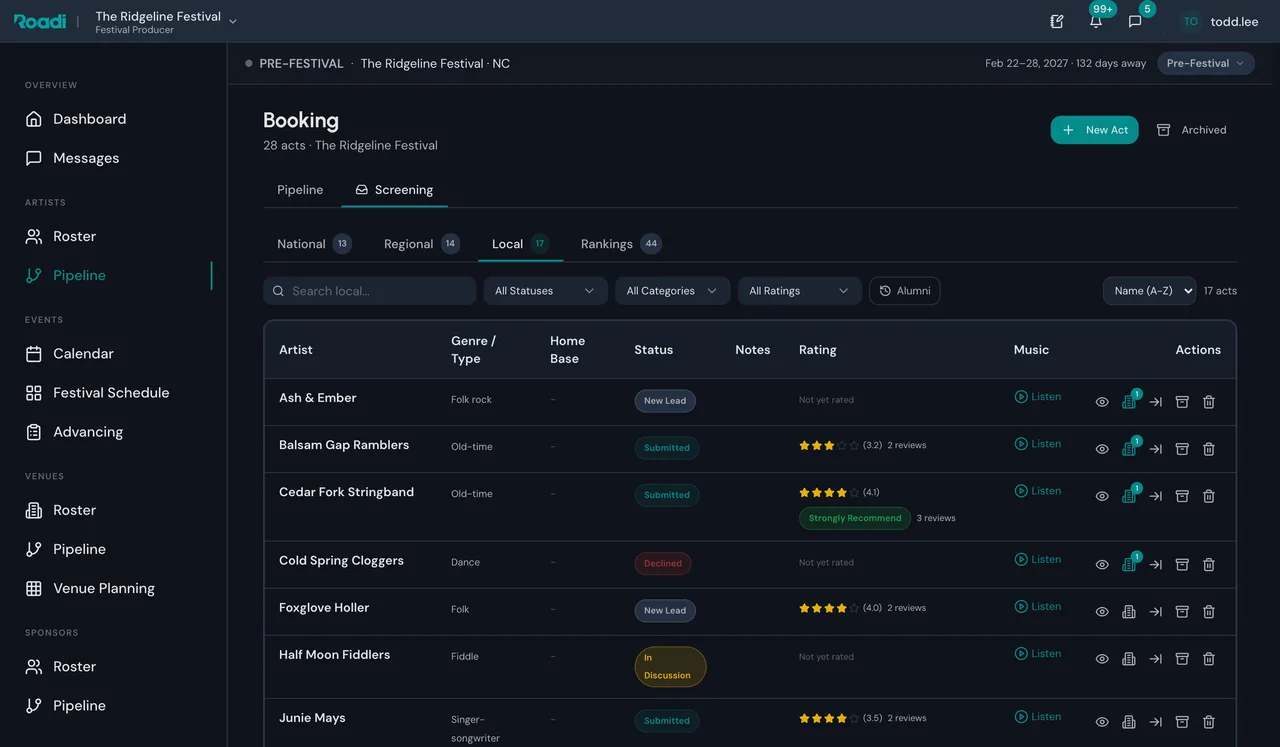
Every act in one list, from first application to booked
Artists apply through the festival's own website, and every application lands in a single screening list. Acts can be tagged by tradition and filtered by region, so the local old-time band and the touring bluegrass act are easy to find.
Click any act and its full record opens: what the band asked for, who represents them and the draw you expect. When an act has played the festival before, last year's draw is right there to start from.
Curation committee
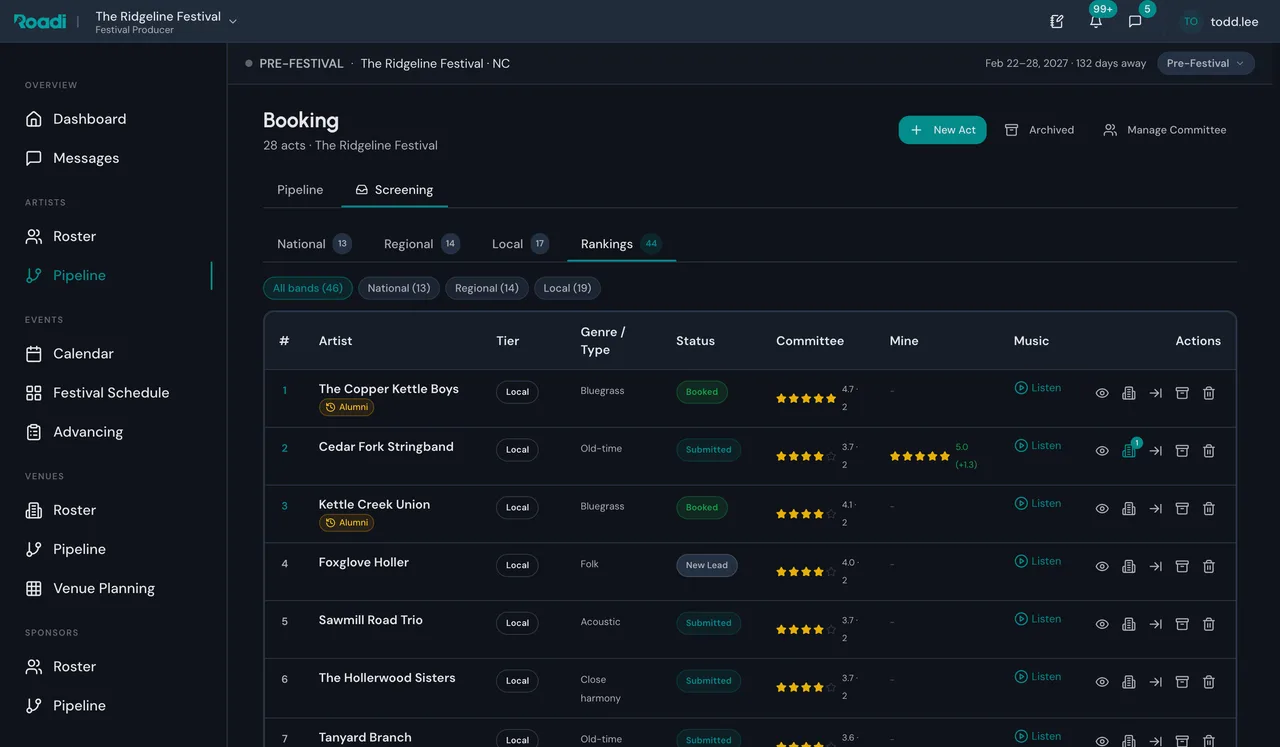
A committee that scores every act, with no logins to manage
The producer invites the committee and sets the categories that matter to this festival. Each reviewer scores acts from a private link, on a phone or a laptop.
Scores add up to averages for every act, so the conversation starts from where the committee actually stands rather than from whoever spoke last.
Venue planning
Every room's weekend on one board
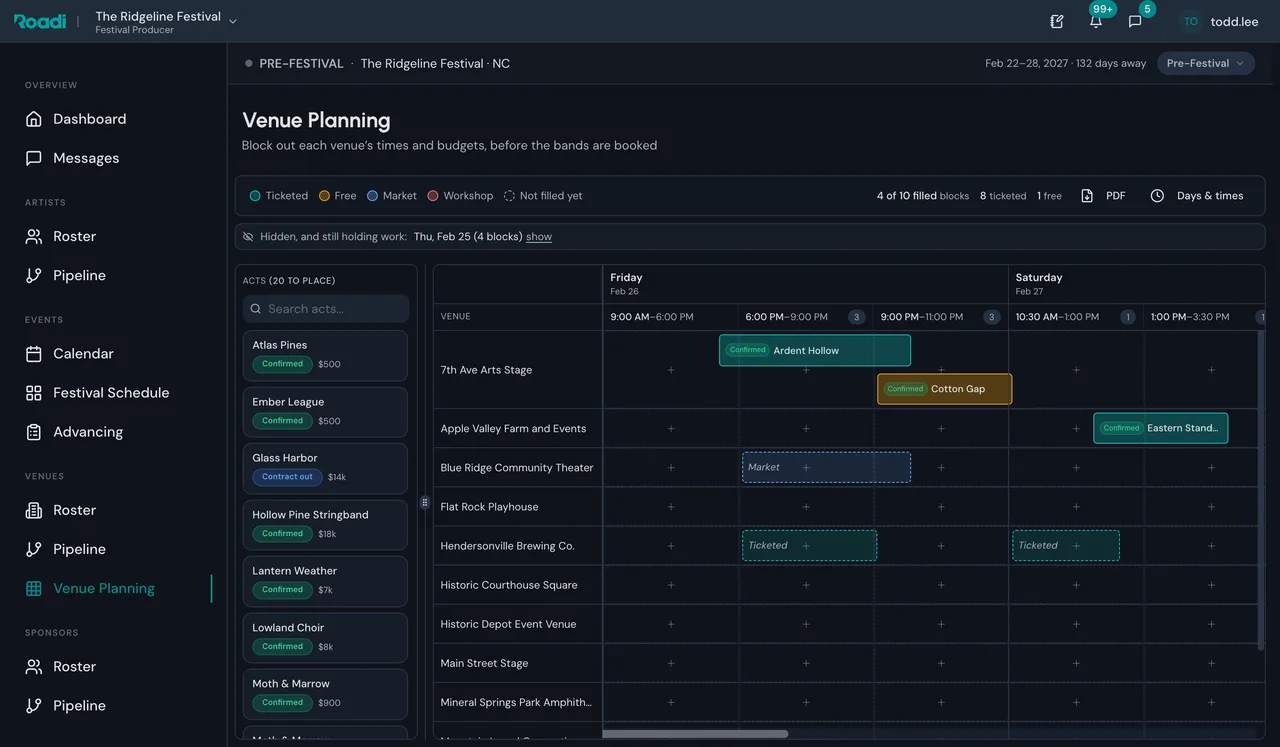
Recruit venues through the same pipeline as acts, then lay out each room's weekend: how many slots, which are ticketed, which are free, where the workshops and jams go.
When acts are confirmed, they move onto the festival schedule across every venue. Roadi will not let two sets overlap in the same room, and it warns you when two headliners would play at the same time in different rooms.
Picks for venues
Venues choose their bands, and the answer comes straight back
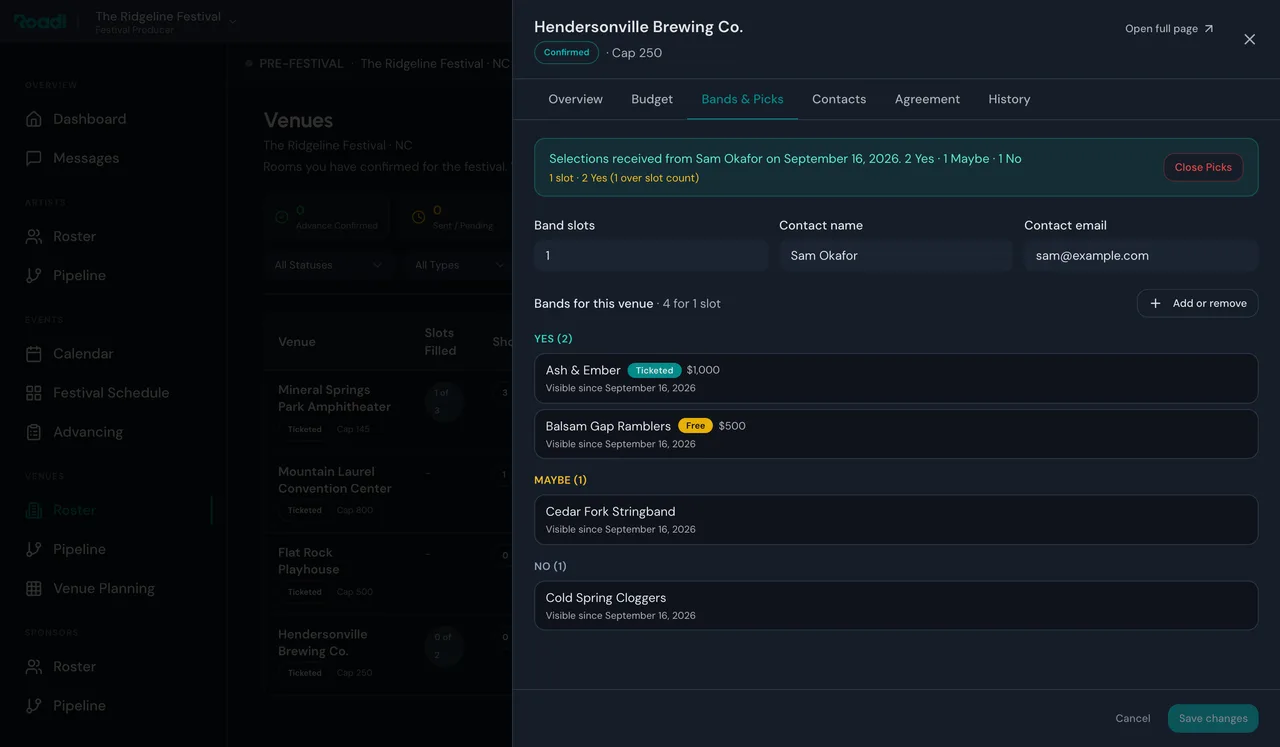
The producer proposes a shortlist of acts to each venue. The venue answers yes, maybe or no, and every answer flows back into planning.
Venues that want more can log in for free and see their own shows and the picks waiting on them. They never see another venue's numbers.
I want to create an ecosystem for the venues, because I have all these venues, and for me, it's what I do every day. For them, it's a random weekend in February.
Budget and sponsors
A festival budget that keeps itself up to date
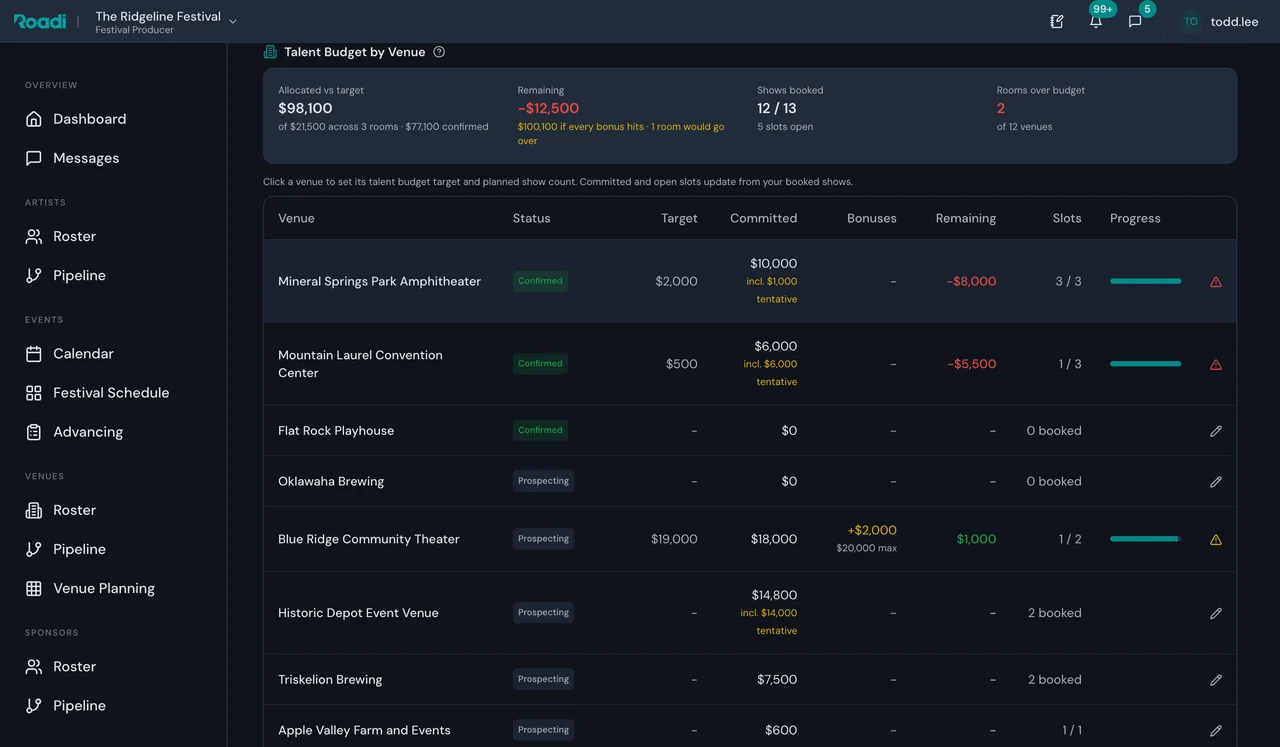
Every category has a planned and an actual figure, and talent and sponsorship fill in from the booking pipeline as deals move. Each venue gets its own talent budget, with a meter that turns red when a room runs over.
Confirmed and tentative deals are kept apart, so a hold never inflates the total. Free shows carry their own split between what the venue covers and what the festival covers, and sponsorship goals track pledged against received.
Last year's festival
Last year's data, inside the plan for this year
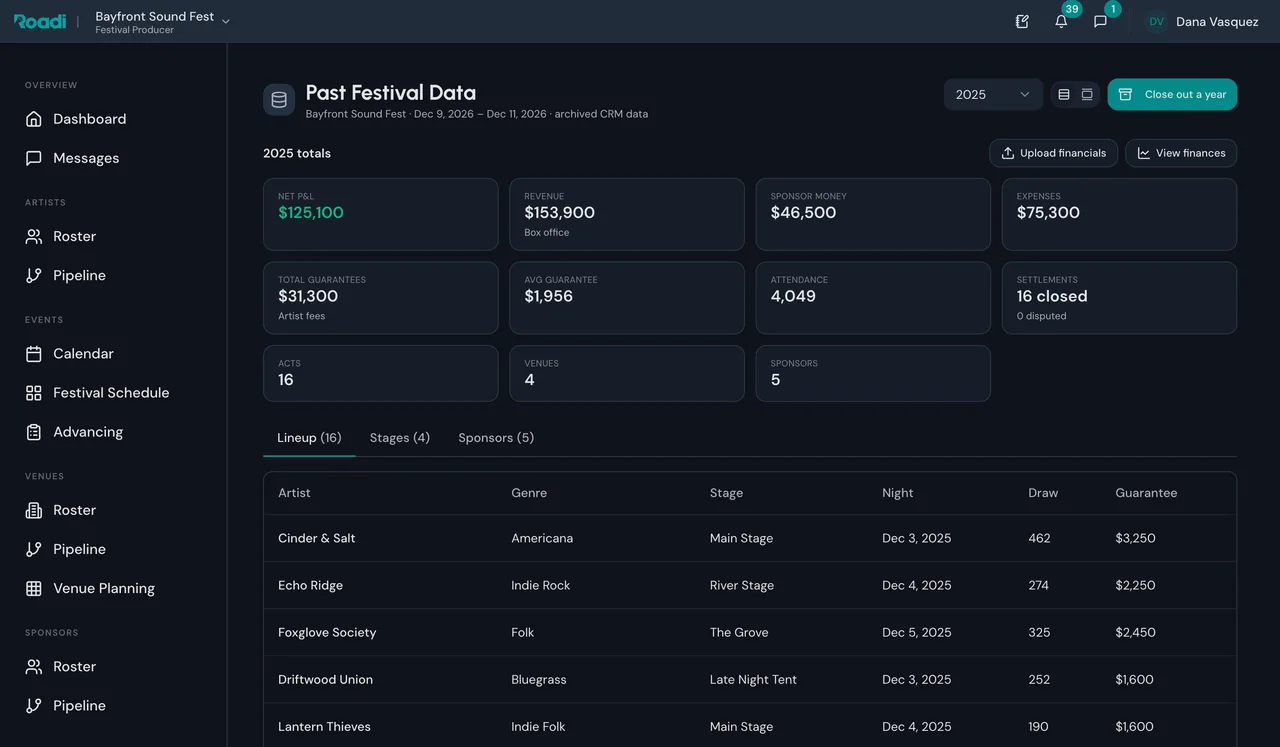
The 2026 festival's schedule, artists, venues, workshops and sponsors live in Roadi, one tab each, instead of in an old export.
When an act returns, last year's draw is ready to prefill. At the end of each festival the year is closed out, so 2027 becomes the starting point for 2028.
Built for how it works
Made for a festival run with partners
A multi-venue festival depends on people who do not work for it: venue owners, volunteer reviewers, artists, sponsors and community partners. Roadi gives each of them a place in the plan without extra work.
The committee needs no account
Reviewers score acts from a private link. Nobody on a volunteer committee has to set up a password to take part.
Every venue gets its own dashboard
Venue partners log in free to see their shows, their talent budget and the bands waiting on their answer. Each one sees only its own part of the festival, so the producer can share openly with every room.
Every application lands in one place
Artists, venues, sponsors and partners apply on the festival's own website, and every answer arrives in Roadi already sorted by type.
Sponsors tracked like a fundraiser
Set a goal for each sponsorship and see what has been pledged and what has actually come in, kept apart from the talent budget.
Ticket sales beside the budget
Sales and capacity come in every day from the festival's own Ticket Tailor account, so the producer sees what each show has sold next to what it costs.
Community partners have a pipeline
Arts councils, schools and heritage groups get their own pipeline, from first contact to confirmed, beside the venues and sponsors.
Before and after
Where the work lives now
| Task | Before | With Roadi |
|---|---|---|
| Artist submissions | Emails and form exports, merged by hand | One screening list, filtered by tradition, region and status |
| Committee review | Shared sheets and side conversations | Each reviewer scores on the festival's own categories, and the averages add themselves up |
| Venue coordination | Every venue on its own, with its own numbers | Every room on one board, with slots, budgets and the acts proposed to it |
| Matching bands to rooms | Memory and a phone call | A shortlist for each venue, answered yes, maybe or no |
| The budget | A spreadsheet, rebuilt every time a deal changed | Live totals from the booking pipeline, with confirmed and tentative kept apart |
| Ticketing | Each venue on its own ticketing site | Ticket sales coming in from the festival's own ticketing account |
Artist submissions
Before
Emails and form exports, merged by hand
With Roadi
One screening list, filtered by tradition, region and status
Committee review
Before
Shared sheets and side conversations
With Roadi
Each reviewer scores on the festival's own categories, and the averages add themselves up
Venue coordination
Before
Every venue on its own, with its own numbers
With Roadi
Every room on one board, with slots, budgets and the acts proposed to it
Matching bands to rooms
Before
Memory and a phone call
With Roadi
A shortlist for each venue, answered yes, maybe or no
The budget
Before
A spreadsheet, rebuilt every time a deal changed
With Roadi
Live totals from the booking pipeline, with confirmed and tentative kept apart
Ticketing
Before
Each venue on its own ticketing site
With Roadi
Ticket sales coming in from the festival's own ticketing account
Producing a festival across many venues?
See everything a festival gets on Roadi, from the first application to the last settlement.
By the numbers
What's in place for 2027
Planning, not results
- acts in screening for 2027
- 150+acts in screening for 2027
- committee reviews
- 140+committee reviews
- venues confirmed
- 12venues confirmed
- acts proposed to venues
- 70+acts proposed to venues
- days across Henderson County
- 4days across Henderson County
- working sessions since March
- 10+working sessions since March
What's next
The road to February, and past it
March 2026
First conversation
Ryan walks us through a festival that runs across a county, not a single field.
Summer 2026
The producer's toolkit takes shape
Budgets, venue talent targets, sponsor goals and last year's festival brought into Roadi.
July to August 2026
Artist submissions open
Applications from the festival's website land straight in Roadi for screening.
Fall 2026
The committee scores, the venues pick
Reviewers rate every act, and venues start answering yes, maybe or no to the bands proposed to them.
February 25 - 28, 2027(planned)
The Winter Ramble
Four days of mountain music in rooms across Henderson County, North Carolina.
Spring 2027(planned)
Close the year, plan the next
The 2027 edition is closed out in Roadi and becomes the starting point for 2028.
Volunteers, from sign-up to check-in
Volunteers already apply on the Winter Ramble's website and land in Roadi. Before February, Ryan builds his crew there: shifts at each venue, a schedule link for every volunteer, check-in on the day, and a note on who to invite back next year. The Winter Ramble is the first festival to use it.
What he will measure
Shows and venues, tickets sold against capacity, talent spend against each venue's budget, and sponsorship pledged against received.
We will update this story after the 2027 Winter Ramble, with what worked, what did not, and what we changed.
I'm gonna be talking to venues, bands, sponsors, partners, volunteers, and using Roadi to build the festival out. That's not only saving me time, it's allowing me to do this without having to hire an admin person.
Questions from festival producers
What producers like Ryan ask before they move their festival onto Roadi.
What is a multi-venue music festival?
Is there festival management software for multi-venue festivals?
Does Roadi work for a festival with several stages at one site?
Can a curation committee review acts without a Roadi account?
Do venues get their own login?
Can artists, venues and sponsors apply from our own website?
Does Roadi sell tickets for the festival?
Building a festival?
We built Roadi with the people who use it. If you produce a festival across venues or stages, a weekend or a downtown music crawl, let's talk about how Roadi can help.