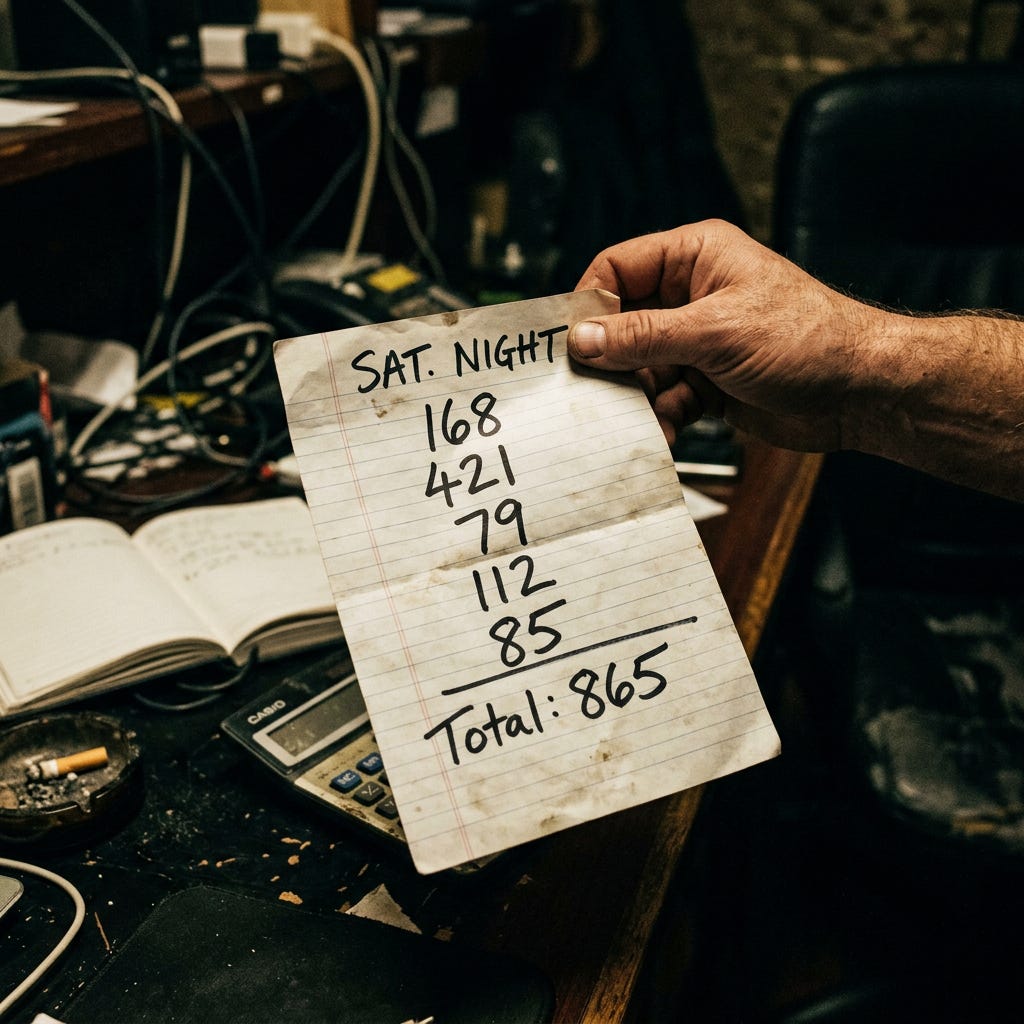
Settlement Night. The Part Nobody Talks About.
End-of-night settlement involves calculating payments from door counts, bar revenue, deductions, and deal math. Without shared systems, disputes arise and everyone leaves uncertain.
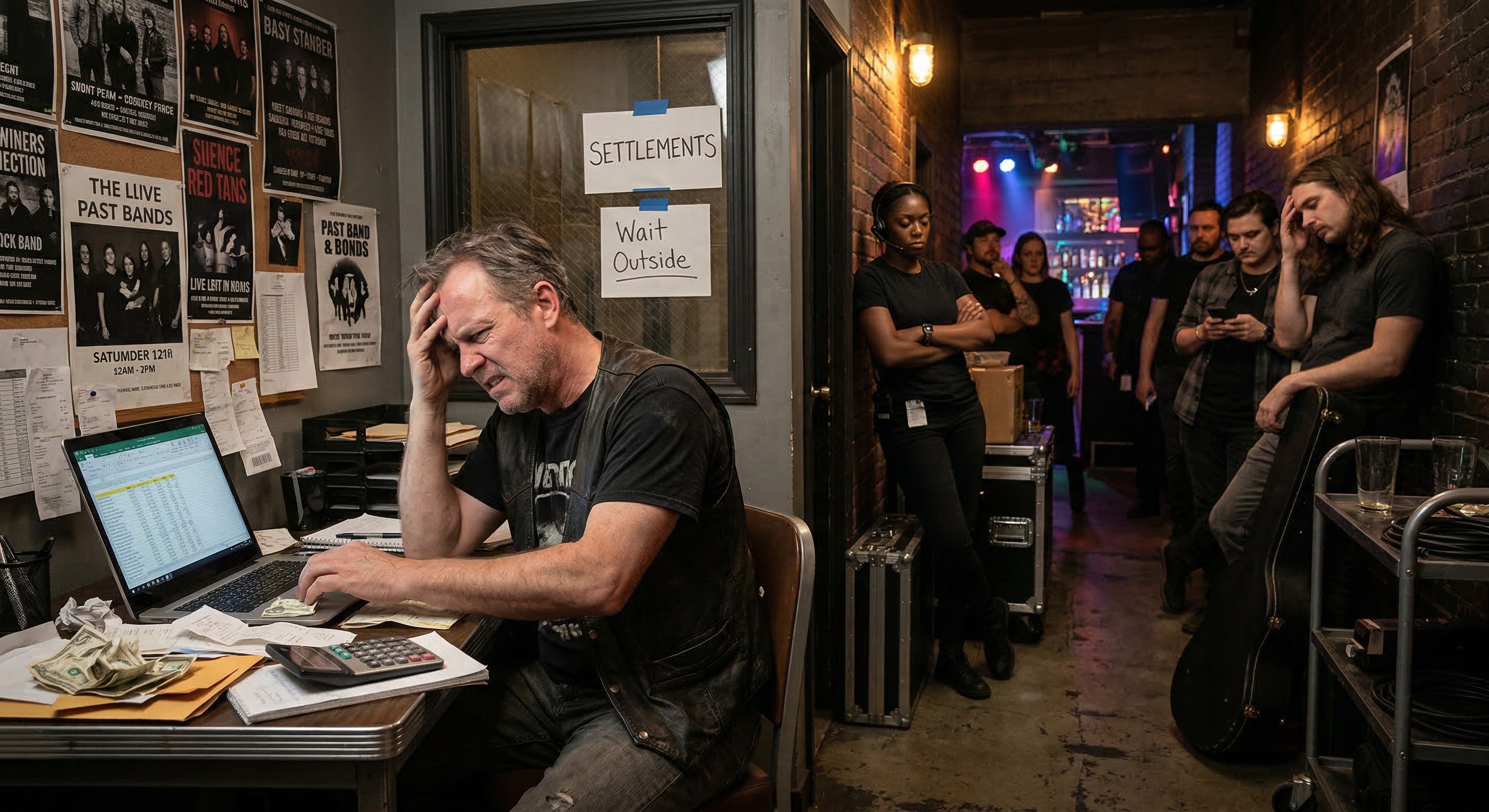
Ask anyone who has worked the back end of a live music show about settlement night and you will get one of two responses. Either a tired laugh, or a very specific story about a very bad night.
Settlement is the moment at the end of a show when everyone who is owed money figures out what that number actually is. The venue, the promoter, the artist, sometimes the agent. All of the moving pieces come together in someone's office, or at the bar, or outside in a parking lot, and the math has to work out.
It sounds straightforward. It almost never is.
The deal that was made weeks or months ago was made on certain assumptions. A ticket count. A split percentage. A cost cap. What the bar does. What gets deducted. What does not. By the time you get to settlement night, the world has changed. The show was a little different than expected. Expenses came in differently. Someone read the contract one way and someone else read it another way. And now it is 1 in the morning and everyone is tired and someone is unhappy with a number.
This happens constantly. Not occasionally. Not at certain venues or with certain promoters. Across the industry, at every level, with some version of this scene playing out every single weekend in cities everywhere.
What makes it worse is that the tools people use to get to that moment are completely disconnected from each other. The original offer was made in an email. The contract was a PDF. The ticket sales came from one ticketing system. The expense receipts are in someone's pocket or photographed on a phone. The door count is in a separate spreadsheet. The bar numbers come from a POS report that the venue manager has to pull and translate manually.
By the time someone sits down to calculate the settlement, they are reconciling information from five or six different sources, none of which were designed to talk to each other. They are doing arithmetic on data they cannot fully verify in real time. And the person on the other side of the table is doing the same thing with their own version of the same data.
It is not surprising that disputes happen. What is surprising is that people are surprised when they do.
Here is the thing: every number that feeds into a settlement calculation was known, or knowable, before settlement night. The deal terms were agreed on. The ticket counts were being tracked. The expense caps were in the contract. There is no reason, structurally, that the final settlement should be a revelation. There is no reason it should be a negotiation. It should be a confirmation of what everyone already knows.
But because the data lives in separate places, and because there is no single system connecting the deal to the financial reality of the show, settlement becomes a process of reconstruction instead of confirmation. You are not closing the books. You are rebuilding them from scratch, under pressure, at midnight.
And then there is the question of what happens after settlement. Where does the record live? If there is a dispute two weeks later, or the promoter needs to review their margins across all their shows, or the venue needs to produce documentation for their accountant, where does anyone go to find a clean, trusted record of what was agreed on and what was paid?
Usually the answer is: back to the email chain. Or the spreadsheet. Or the PDF that nobody is sure is the final version.
I have talked to people at every level of this business about this problem. The response is almost always the same. They acknowledge it, they describe their version of it, and then they say something like, "that's just how it is." As if the chaos is the cost of admission to working in live music.
It does not have to be.
The financial relationship between a venue and a promoter, or a promoter and an artist, is not a mystery. It follows patterns. It has rules. The data that feeds into it exists. What is missing is a place for all of it to live together, from the moment the deal is made to the moment the check is cut.
The people doing this work are professionals. They deserve a professional process.
Settlement night should not be something people dread. It should be the easy part.